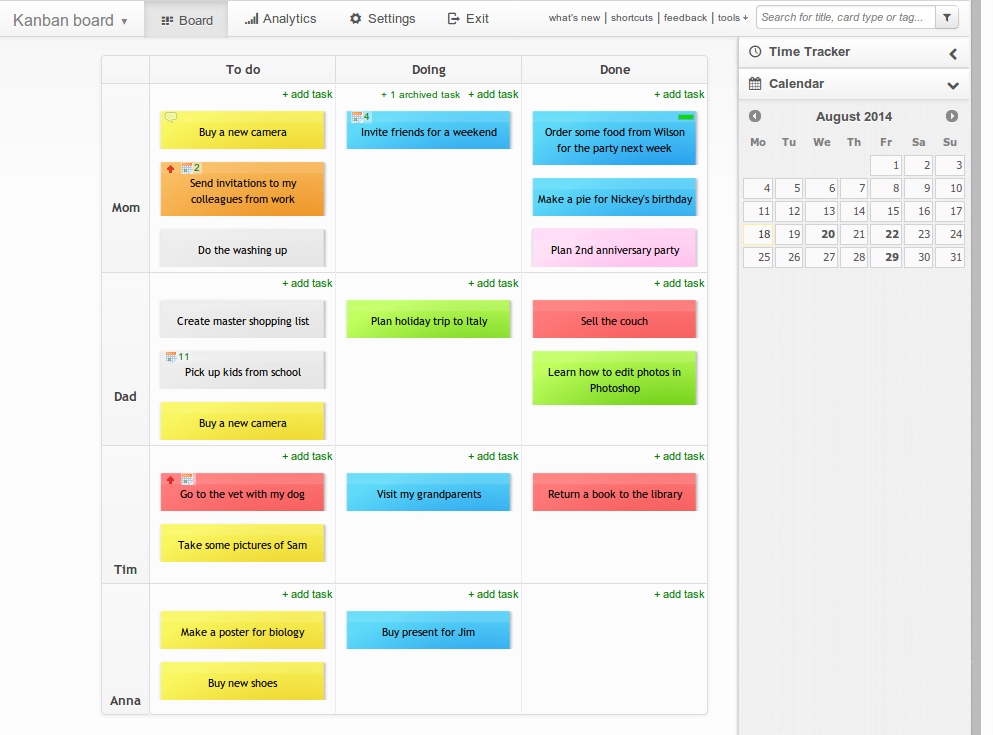
Personal Kanban board example. Source: Bossarro / Wikimedia Commons (CC BY-SA 4.0)
Origins and adaptation for individual use
Kanban originated in Toyota's manufacturing operations in the 1940s as a visual scheduling system for production lines. The method was adapted for software development teams in the 2000s — notably by David Anderson's work on software Kanban — and later formalised for individual use by Jim Benson and Tonianne DeMaria Barry in their 2011 book Personal Kanban: Mapping Work, Navigating Life.
Personal Kanban strips the team-oriented machinery of software Kanban — service delivery frameworks, cadences, flow metrics — down to two rules: visualise your work, and limit your work in progress.
The minimal board structure
A Personal Kanban board at its simplest has three columns:
- Backlog (Ready) — all tasks available to start
- Doing — tasks currently in progress, limited by a WIP cap
- Done — completed items
Most practitioners expand this over time. Common additions include a "Waiting" column for items blocked on external input, a "Today" column to highlight daily priorities, and categorical columns such as "Reviewing" or "Testing" for work that has specific intermediate stages.
Work-in-progress limits
The WIP limit is the defining constraint of Kanban. For personal boards, practitioners typically set limits of one to three items in the "Doing" column. When the limit is reached, no new card moves to "Doing" until an existing card moves to "Done."
The purpose of the WIP limit is to surface bottlenecks: if cards pile up waiting to enter a column, it indicates that the person is either overloaded, that certain task types take much longer than estimated, or that there are dependencies blocking progress. Without a WIP limit, boards become visual to-do lists rather than flow management tools.
Setting realistic limits
A common starting point is a WIP limit of two for knowledge work tasks. Practitioners typically adjust this over several weeks based on observed flow: if items consistently complete before the limit is reached, the limit may be set lower to enforce focus; if legitimate parallel work streams require it, the limit may be raised.
Physical versus digital boards
Physical Kanban boards — sticky notes on a whiteboard or a section of wall — are widely used for home-office settings. The tactile movement of a card from "Doing" to "Done" has a reported motivational effect that digital alternatives partially replicate with animations.
Digital tools popular in Poland include Trello (free tier, Polish interface), Notion (configurable boards within a notes system), and Microsoft Planner (available within Microsoft 365 subscriptions common in Polish corporate environments). KanbanFlow and Wekan are alternatives with built-in Pomodoro timer integration.
Combining Personal Kanban with GTD
GTD and Personal Kanban address different parts of the productivity workflow. GTD provides a systematic capture and clarification process that determines what tasks exist and what the next action for each is. Personal Kanban provides a visual flow system for executing those tasks.
A typical combination maps GTD lists to Kanban columns: the GTD "Next Actions" list becomes the Kanban backlog, projects with defined next actions are cards, and the "Waiting For" list corresponds to the Kanban "Blocked" or "Waiting" column. Weekly GTD reviews also serve as the Kanban retrospective, reviewing flow and WIP adherence.
Personal Kanban was described in detail by Jim Benson and Tonianne DeMaria Barry in Personal Kanban: Mapping Work, Navigating Life (Modus Cooperandi Press, 2011). The original Kanban method for software teams is documented at kanban.university.
Flow metrics for individual use
Team Kanban relies on throughput, cycle time, and cumulative flow diagrams. For personal use, simpler tracking typically suffices: a count of cards completed per week (throughput), and an occasional review of how long cards spent in the "Doing" column (lead time). These numbers, tracked informally in a notebook or spreadsheet, reveal patterns in work speed and identify categories of tasks that consistently stall.
Retrospectives and board evolution
A Personal Kanban board benefits from periodic review — roughly monthly — to assess whether the column structure still reflects the actual workflow. Columns that items rarely pass through may be redundant; frequently encountered states with no dedicated column may warrant addition. This iterative refinement is described in Benson and Barry's writing as "kaizen" applied to personal work design.
Further reading
The source text for Personal Kanban is Benson and Barry's book (2011). The Kanban University website at kanban.university covers the team-oriented Kanban Method. For related execution frameworks, see the articles on GTD and the Pomodoro Technique.